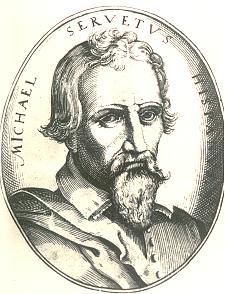
I'm a Servetian


I've always had some envy of Quakers who have a strong sense of who their founder was - George Fox - and all Quakers know that and still talk about Fox. Unitarians have less of a sense of a founder, and this gives us less of a sense of identity.

Recently though I've started to read more about Michael Servetus. And I've started to really warm to the idea that he is our founder, and should be viewed as such. True, he didn't start a community, but then, neither did Jesus. True he wasn't perfect, but then, neither was Jesus.

I've recently gained more insights into Servetus that I didn't appreciate before. He was an ethnic minority as a dark-skinned Spanniad in France. He was a healer as he worked as a doctor. He read the Qur'an, and possibly read Arabic, and had a very positive approach to Jews and Muslims. He suffered a death for what he believed in, much like Jesus and Al Hallaj.

But mostly I love his mysticism, his sense of God within, that I'm beginning to think is the very essence of Unitarianism. This is the great mystical strand of Unitarianism that we've lost too much. It's just as important as the rational side.

I think we're very impoversished when British Unitarians only trace ourselves back to Priestley and Lindsey, and Americans only trace themselves back to Channing. I think we're a global family with many branches that starts with Michael Servetus.

Right now I feel like being Unitarian means following Servetus.

Comments

Anonymous said…
Wouldn't you trace it all the way back to King Sigismund since he first codified freedom of religion when Unitarianism was brought before him?
Anonymous said…
would Servetus, Priestley, Channing et al recognise modern Unitarian-Universalism as the faith community they sought to develop?

a typical UU contradiction - rejecting Christ, yet championing Servetus
Great to know about your interest in Servetus, Stephen. I am also a Servetian Unitarian, and I think that the main elements of historical Unitarianism (not just rejection of the Trinity, also freedom of speech in churches, radical criticism of received dogmas, search for the pure religious experience untainted by human manipulation, that we need to pay attention to the wisdom found in religious traditions other than our own, that we all are sons and daughters of God and God is in everything and in everyone...), everything that is truly Unitarian can be found in seminal form in Servetus's thought.

I recommend that you visit the website of the Michael Servetus Institute (of which I am a member), which preserves his legacy:
http://www.miguelservet.org (click the English version of it)
Anonymous said…
did Servetus proclaim himself Hanif?
Anonymous said…
I'm a former JW who sees good things in Servetus - I definitely share similarish beliefs about the Lord.

but what seems funny is how after tearing up most of their history and identity, your church still claims Servetus as their patron saint. why is this?
Anonymous, Servetus said that the Muslims, unlike the Trinitarian Christians, had got it right about God and Jesus, and extensively quoted the Qur'an to support that view. See Peter Hughes's article on the issue published last year in the Journal of UU History. That was an extremely odd and dangerous thing to do in 16th-century Europe, and it was one of the strongest arguments that the Geneva officials used against him. If you want to call it hanif...
Bart: Servetus definitely came before Sigismund, and had an influence on him, I think via Bladratta (spelling?)

Tony S: You make a good point, but personally I'm not rejecting Christ at all.

Jaume: yes to everything you said. Does the Servetus Institute have any plans to translate the major works of Servetus into English (or Spanish, French, Hungarian) in print or online? I'd love to get into his own writings.
Anonymous said…
So basically what jamue is saying is "SERVETUS AGREES WITH ME". Which is fitting the 'Servetian' label to YOUR belief system and not vice versa. But as tony said most UUs reject Christ which Servetus NEVER did.
Prince Sigismund was never a theologian, he was a politician (and a rather weak one, BTW). The Unitarian Reformation in Transylvania has its origins in Servetus via Blandrata, who influenced Ferenc (Francis) Dávid, the court's preacher and Calvinist superintendent. Servetus's influence in Dávid's work has been shown by Stanislas Kot, Mihály Balázs, and others.

On books: the complete works of Servetus are being edited these days with funds from the autonomous Government of Aragon, in a bilingual Latin/Spanish edition. You can see the books in the shop of the website I quoted above.

As for English, the first two theological books were translated by E.M. Wilbur in the 30s', and now there is at least one translation in progress of the Restitutio in the USA. It will probably be published in several volumes and not just one, to facilitate the process. I cannot give further details for the moment...
Did you get the dark-skinned Servetus from "Out of the Flames"? This is not an accurate book. AFAIK there are no reliable pictures or physical descriptions of Servetus. All early pictures were drawn years after his death. Besides, being a Spaniard does not mean that you are dark-skinned. He was born in the northernmost area of Aragon, and his father's family came from a hamlet in the Pyrenees, therefore he must have been rather pale-skinned for Spanish standards.
Anonymous said…
Stephen,

Thanks for answering the questions raised.

It really is great to see a Unitarian-Universalist blogger that can address issues directly without having to fall back on the usual monologues about tolerance etc.

Keep up the good work,

Tony

Popular posts from this blog

Swords into Ploughshares

  "They shall beat their swords into ploughshares, and their spears into pruning hooks; nation shall not lift up sword against nation, neither shall they learn war any more." Isaiah 2:4 Palestine Action are doing just this: beating swords into ploughshares i.e. putting weapons out of use. In doing so they are fulfilling this biblical mandate. They are expressing God's peace as expressed in the Jewish tradition and the Christian tradition. God desires that our swords shall be beaten into ploughshares, that we should unlearn war. That the government wants to make this action illegal has to be confronted in the strongest terms. To rush to condemn attacks on weapons but not attacks on children is perverse. To call attacks on weapons terrorism but not attacks on children is perverse. When government comes to such an extreme position - legislating that peace is war, that weapons need more protection than children - then they have fundamentally gone wrong. This is the definitio...

Is humanism theologically tolerant?

OK, well this might be controversial, but I feel the need to say it. Is humanist tolerant? Please note I'm not asking about humanism within society. Clearly humanism certainly believes in tolerance within society and I'm forever glad they are often the only people in the media calling for a separation of church and state. No, what I'm talking about is descriptions of Unitarianism like this and adverts like this , discussed at Peacebang here , which say that humanism is one option, Christianity is another, God is one option among many. The trouble is, humanism, by definition is theologically opposed to theism. This is very different from the relationship between Christianity and Buddhism. These two traditions may be vastly different, but Buddhism, by definition , is not opposed to Christianity, and Christianity, by definition , is not opposed to Buddhism. But humanism is consciously defined in opposition to Christianity and theism. So to say that humanism and theism can bot...

Clergy-wear during protests

OK, I'm wandering into the territory of Beauty Tips for Ministers here, but a couple of recent conversations have brought up the issue of what clergy should wear for protests. I know a number of Ministers who only wear clerical collars for protests. The logic is that it's important to identify as a Minister when you're supporting something society doesn't expect clergy to. So Ministers will wear a collar at gay prides or pro-choice rallies to make this point. Now I could understand this if it you wore a collar going about your general business, and also did during a protest, but I'm quite uncomfortable with the idea of wearing clerical wear ONLY for protests. The seems to be something worth exploring. I have said before that I'm not in favour of special titles or clothing for religious leadership, mainly because Jesus explicitly said this was a lot of nonsense. Religious leaders should not need these articial crutches. I have no problem with certain liturgical c...